Process Automation
Automation starts with understanding the work, not the tool. I map the workflow thoroughly before automating a single step, because that's the difference between automation that sticks and automation that quietly breaks the moment reality doesn't match the diagram. And the automation itself is built by a working AI pipeline, not just promised by one.
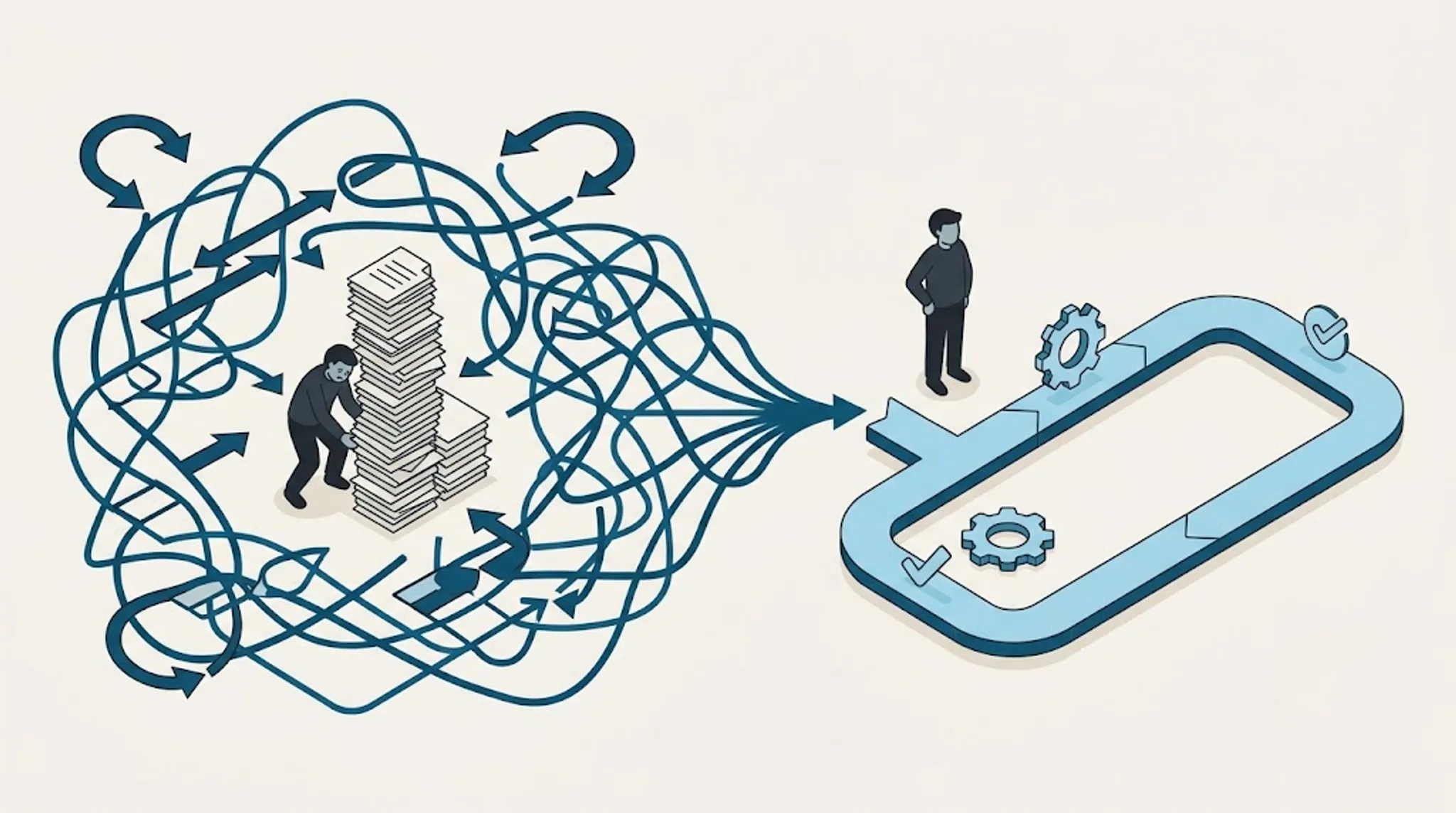
It all starts with conversations with the users on the front lines
The best technology is worthless if nobody on the floor will use it. So I start with the people doing the work, not the tool: cutting repetitive tasks, clearing bottlenecks, and speeding up the handoffs where the fastest ROI usually hides. For one wholesale distributor that meant roughly 1,700 finance transactions a month now posting themselves, about 20 hours a month handed back to the bookkeeping team. Not theory. Running in production today.
The blueprint: automating without blowing the budget
A good plan makes all the difference. I build with lean, agile principles, so the people who actually use the workflow get their eyes (and when possible, their hands) on it in a testing environment within days, not months. I manage scope and budget tightly: every addition gets weighed and signed off, and if a change isn't essential, I defer it to a later phase so you start seeing ROI sooner rather than later. That discipline is how a custom purchasing automation a traditional team estimated at ~240 hours came in at about 35.
I test the messy edge cases, then watch it in production
Before anything goes live, I test it as hard as I can, both the happy path and the edge cases. And I'll tell you when something shouldn't be automated at all: if a process is broken, fix it before you automate it, or you've just made the mess run faster. The rare edge cases that aren't worth the engineering get an off-ramp that hands them back to a human. After launch I keep watching: a dashboard where the work earns one, and always an alert the moment something fails to run. No silent failures.
What I automate
Order-to-cash, hands off
The flow that quietly eats the most labor: orders that auto-create their sales order, invoice, and applied payment with no manual entry. For one distributor that's ~1,700 transactions a month and ~$170K invoiced and collected automatically, straight into the books.
Gated onboarding workflows
Employee, customer, and vendor onboarding that won't let a step get skipped: each gate has to clear before the next opens, so nothing slips through and nobody chases a missing form.
Customer & vendor portals
Self-service sites so customers and suppliers transact directly instead of phoning and emailing your team. Fewer handoffs, fewer things lost in someone's inbox.
Dashboards that sound the alarm
Employee, department, and executive dashboards built to do one job well: show whether the business is running as it should, and flag it the moment it isn't. A dashboard only when the work earns one.
“Mike is very knowledgeable... If he does not know the answer to a question, he always takes the time to research and/or test and then follow-up with a response (rather than bluffing his way through an incoherent response). We appreciate that. Mike offered a good balance between making recommendations / best practices and assisting us to customize our instance to meet some of our business processes.”
The DreamSight difference
It's the pipeline, not the headcount
It would be strange to preach automation and deliver it by brute force. I don't: the way I build is itself automated, a real AI pipeline in production today.
Solving a business problem well used to take a room of people (analyst, architect, developers, a senior reviewer, QA, DevOps) and the meetings and handoffs between them. I know that model from both sides: I scaled a consulting firm that worked exactly that way, and I ran my own companies on the systems I built myself. So I replaced the room with a delivery pipeline. Thirty years of judgment scopes and reviews every request, and a team of AI agents I built and trained does the volume in between.
It's a real pipeline, in production today, not a slide deck about one. And it isn't tied to any one platform: the same process delivers on whatever systems you already run. The result is simple. I ship in hours what a traditional consulting team takes a week to deliver.
Ready to put technology to work for your business?
A 25-minute, zero-pressure call. We'll talk through where AI and automation will pay off fastest in your business. No obligation, no hard sell.